
Centennial Park has three built heritage sites.
- A partially-buried WW2 pillbox, located on the edge of Pupuke Golf Course 13 th tee, can be accessed via a short path off the northern end of the Mamaku Track.
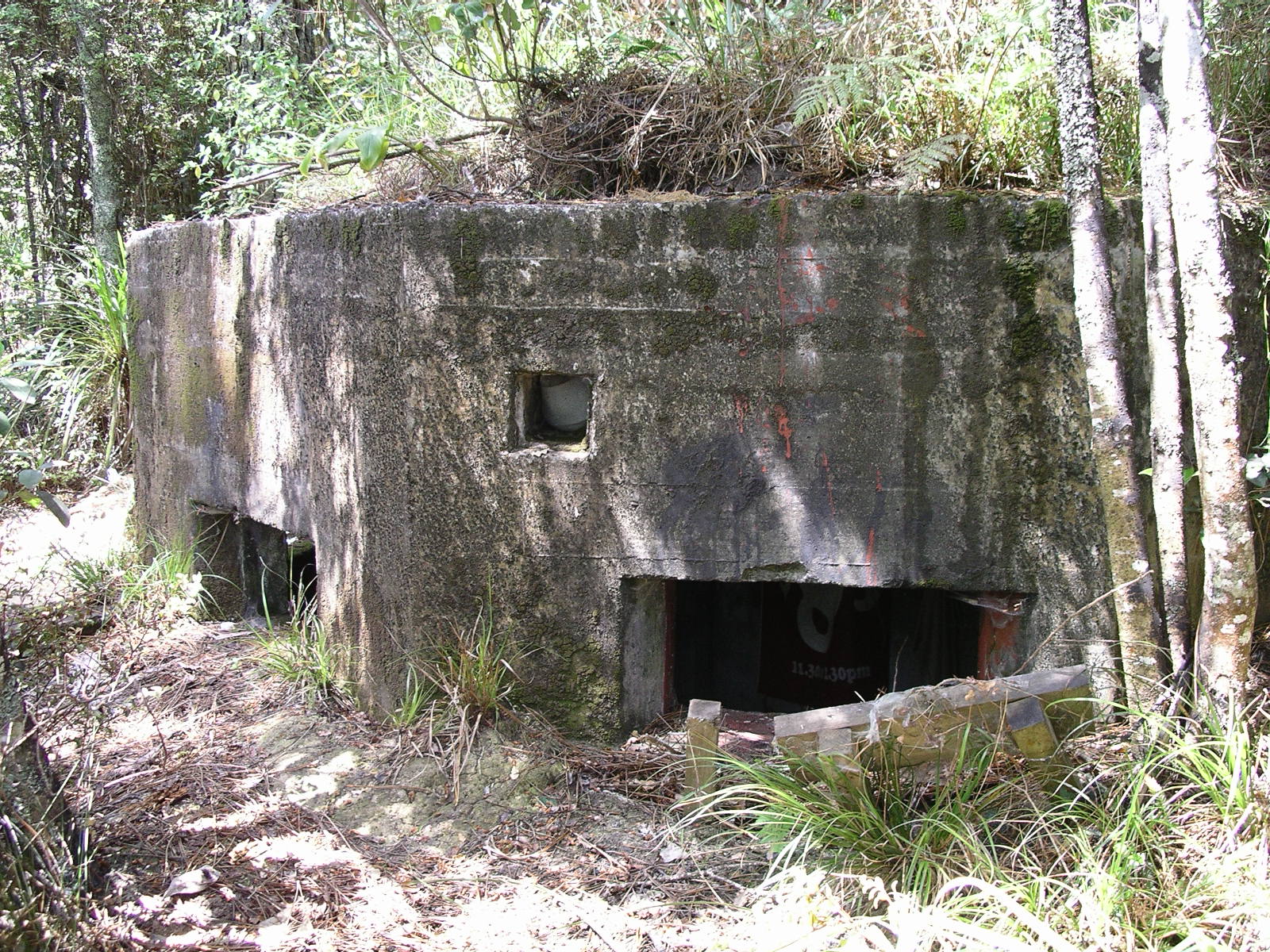
- A second WW2 pillbox (pictured below) is signposted off the southern end of the Mamaku Track.
- The remains of a kauri gum digger’s hut are (just) discernible along the Kohekohe Track.
In addition, the Avenue of Remembrance, a double row of mighty pohutukawa, runs from Beach Road entrance to Rae Road entrance. The trees were planted in 1940, to commemorate New Zealand’s centenary.
History
Centennial Park in the heart of Campbells Bay is one of the Auckland region’s oldest public reserves. It covers an area of 73.5ha, bounded by East Coast Road to the west, Kowhai Road to the northwest and Beach Road to the east. The park is owned by the Crown and managed by Auckland Council. Pupuke Golf Club leases 44.5ha, zoned Open Space – sports and active recreation. The remaining 29ha of regenerating native forest are zoned Open Space – conservation, with Significant Ecological Areas.
Prior to Polynesian arrivals, around the 13 th and 14 th centuries, the Auckland isthmus was densely clothed in conifer-hardwood (podocarp) forest including kauri and rimu. Birdlife was varied and abundant and coastal waters and intertidal zones teemed with life. The North Shore was settled by Tamaki Māori, including people descended from the Tainui migratory canoe. Among the iwi associated with the East Coast are: Ngāti Manuhiri, Ngāti Maraeariki, Ngāti Raupo, Ngāti Paoa, Te Kawerau ā Maki, Ngāti Whātua, Ngāti Kahu and Ngāti Poataniwha.
The coastal land offered good fishing, fresh water, fertile soil and natural defence opportunities. A number of Māori settlements were established and hilltop pa were constructed – the closest to Centennial Park being Rahopara Pa at Castor Bay. Over time, poor inland soils and the threat of warfare between tribes to the south and to the north encouraged many North Shore iwi to relocate elsewhere. Raids of the 1820s left the North Shore virtually devoid of people, with a few iwi returning in the 1830s.
By 1840, when Auckland was established, the trees were gone and the isthmus was covered in bracken and manuka and kanuka scrub, with forest remnants in gullies, valleys and sheltered places. From 1840 to 1854, the entirety of the North Shore, from Devonport to Mahurangi, was purchased by the Crown.
European settlement in what became Campbells Bay dates back to 1852. The bay changed hands several times before being purchased and named after Duncan Campbell in 1895. On 17 May 1884, an inland area of gullies and scrubland deemed unsuitable for settlement, was permanently reserved under the 1881 Public Works Act. It became known as Takapuna Domain.
By the early 1900s, the beaches of the East Coast had become important for public recreation. Holiday baches were built and camping parties visited Takapuna Domain. Small farms and orchards characterized the rural hinterland and Māori and settlers dug for kauri gum in the gullies. A gumdigger camp operated in Takapuna Domain as late as the 1920s. Takapuna Golf Club was formed in 1914, operating on 80 acres (32.4ha) of leased Takapuna Domain land. The club was renamed Pupuke Golf Club in 1918.
Takapuna Domain was renamed Centennial Park in 1940, to mark the centenary of the signing of Te Tiriti o Waitangi. That year, an avenue of pohutukawa was planted between the Beach Road and Rae Road entrances by members of the Campbells Bay Progressive Association as a centennial gift and memorial.
The Centennial Park Bush Society held its inasugural meeting on 19 April 1979. Council entrusted CPBS with managing the reserve’ regenerating forest, including weeding, planting native species and track formation. Pat Morton, wife of University of Auckland zoology professor John Morton, was founding chair and held the role until Dr Richard Hursthouse became second chair in June 2003.
The plaque marking the Avenue of Remembrance was installed in May 2006 and the road through the park was named Morton Way in memory of Pat and John. Since Centennial Park Bush Society was founded volunteers have planted thousands of native trees in the regenerating forest and other bush blocks. They remove weeds, control pest animals, maintain the 4.7 km of tracks and fence and restore the 6km stream network.
 Campbells Bay Urban Sanctuary